

 16:56
16:56


Sleep is an active and vital state that builds and nourishes mental and physical health. It stocks your memory banks. It soothes your emotions. It pumps up your muscles, eases your stress, bolsters your immune system, fights dementia, and even keeps the pounds off. Just because you are not fully conscious while this is happening doesn't mean that sleep isn't crucial. While not all animals experience it in the same way, sleep has been developed and nurtured for over 3.5 billion years of evolution.
Sleep science has made rapid advances since the invention of devices that can read brain waves and track mental activity. Sleep has distinct phases, taking the brain on a journey of rest and reorganization. All living things follow daily cycles, which guide everything from our body temperatures to our mental alertness. The social costs of sleeplessness can range from increased traffic accidents to medical errors to industrial disasters on the scale of Chernobyl. In this blog series, we will look into more details about what we know and don't yet know-about sleep, its impact on health, and how you can improve your own sweet slumber.

While the sleeping body rests, the sleeping mind is still active. Sleep is very critical for our survival yet sleeplessness is on the rise everywhere. In today's brightly lit 24/7 society, we fight sleep with caffeine and willpower, struggling to get in just one more hour of work or entertainment. The result: Our memories are foggier, our reflexes are slower, and our bodies are sicker. It's time we stopped taking sleep for granted. "It seems as if we are now living in a worldwide test of the negative consequences of sleep deprivation," says Robert Stock Gold, director of the Center for Sleep and Cognition at Harvard Medical School.
We all are slaves to the clock. Not to the numbers on your watch dial or smartphone but to a more demanding master: the body clock. Your sleep/wake cycle, body temperature, mental agility, moods, athletic performance, appetite, sexual desire, and more increase and decrease on a regular cycle known as a circadian rhythm. (Circa from the Latin for around" and dian from the Latin for "day." so "around a day.") The sleep/wake cycle is the most obvious daily rhythm, and for most of history, people logically assumed that it was dictated by daylight.
An experiment in 1938 proved this wrong. University of Chicago sleep scientist Nathaniel Kleitman and Bruce Richardson, camped out for 32 days in the total darkness of Kentucky's Mammoth Cave, to see how their bodies would respond in the absence of external cues. What they found: Even without daylight their bodies adhered to regular cycles of sleep and body temperature ups and downs. How ever, the cycles were not precisely 24 hours long. Over time, they gradually lengthened to somewhere between 24 and 28 hours.
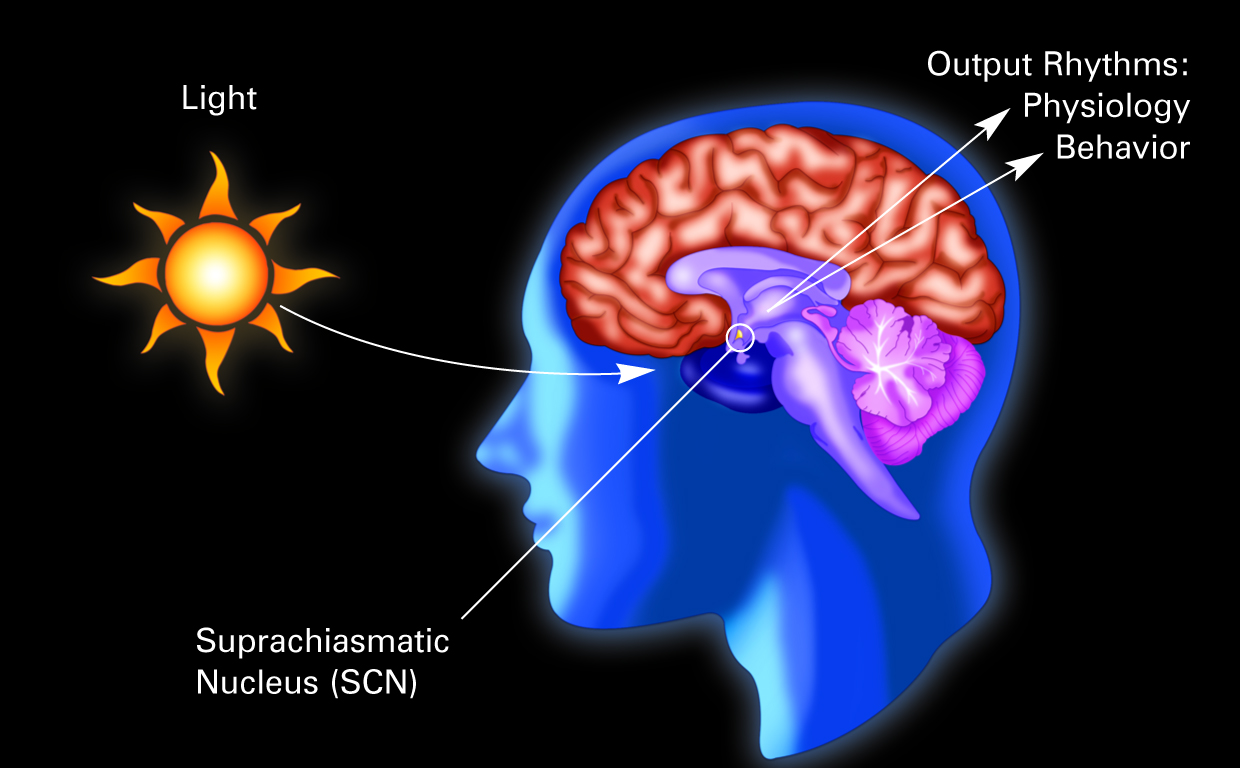
Today we know that every human body is governed by a biological clock in the brain, a tiny region called the suprachiasmatic nucleus. The suprachiasmatic nucleus (SCN) is a tiny structure with an outsize influence on our lives. The cluster of 20,000 or so neurons is located in the lower-middle part of the brain, just above the point where the optic nerves from each eye cross, The SCN follows its own innate daily rhythm as it signals other parts of the body such as the pineal gland and the hypothalamus to regulate sleep. temperature, hunger, and more. Outside cues also keep it on track. Impulses from the nearby optic nerves travel to tell the SCN If it's bright outside.
However, outside cues such as light, temperature, and meals also influence circadian rhythms. Known as zeitgebers (from the German for "time giver"), these cues help to keep us on a roughly 24-hour schedule that corresponds to night and day. Bolstering the sleep/wake rhythm are several chemicals that the body releases in a daily cycle. Among them are Adenosine and Melatonin. Adenosine is a drowsiness compound, building up in the brain during the day and increasing your need to sleep. When you sleep. adenosine levels fall, only to rise again the next day. Melatonin, a hormone released in the evening by the pineal gland, cues the brain that sleep is (or should be) imminent. Although these mechanisms operate in every human body, each person's clock is set a little differently. "Larks" are best and brightest in the morning, rising early and sleeping early as well. "Owls," the late risers, are slow to get going but still lively late at night.
Perhaps the best evidence of the power of circadian rhythms lies in the experience of jet lag. When you travel to a different time zone, your body clock and the outside environment no longer match up. It's hard to avoid jet lag completely, but most experts recommend a few measures. For example, if you're traveling eastward time zones. Adjust your schedule ahead of your trip, going to bed an hour later each night. Avoid caffeine and alcohol on the airplane On arrival, expose yourself to brighter light in the morning and wear sunglasses in the afternoon Conform to the local time as quickly as possible.

Circadian rhythms also affect body temperature and hunger. Understanding your own body's rhythms can have a positive effect on your daily performance. The majority of people are most mentally alert in the late morning and early evening, and sleepiness in the early afternoon, when they're ready for a post-lunch nap. Athletic performance peaks in the afternoon and early evening. Bright lights at night, including the glow from TVs and handheld screens, are zeitgebers that trick the body into wakefulness.

So far we have looked into the science of sleep, now let's understand in detail the effects of sleep on our health in the next part. Stay tuned!




Thanks for sharing
ReplyDeleteThank you 😊
DeleteThank You for sharing
ReplyDeleteThanks Suchitra 😊🙏
ReplyDeleteVery nicely written science of sleep,sleep is golden chain that binds body to health.... Waiting for part 2 of series.👍✌️
ReplyDeleteThank you so much for your support....Yes part to is on its way.... stay tuned.
DeleteVery nice information about sleep science,truly sleep is golden chain that binds health and body👍✌️
ReplyDelete